
I used to build online communities back when vBulletin and Invision Board ran the internet.
People with real usernames. Real arguments about sick turbo setups at 2 a.m. Real keyboard warriors. Real people who drove for hours to meet total strangers in a parking lot because they’d been talking for two years on a forum and all had something in common. Nobody called it “community building.” It was just “the internet.” Things are a bit different now.
I’m not going to pretend it was some golden age (it really was though). There were banner ads. There was spam. There were trolls so insanely vicious they’d make today’s comment sections look like elementary school milk and cookie story time. But it was small enough that you knew who you were talking to, and you knew they would be there, and you knew if they were not, something was wrong. The relationship was the product. Not gonna lie. I really miss those days.
Then the algorithm showed up. And it didn’t kill community. It replaced it with something that looked like community and paid a hell of a lot better.
Here’s what I believe, and what the rest of this piece of brain dump is going to prove: the brands that win the AI era won’t be the loudest about what they do. They’ll be the clearest about what they mean to the customer, and the most honest about the people behind it.
Value is the message. People are the proof.
How we got so numb
Social networks crushed forums. Then they figured out the real business wasn’t connecting people. It was keeping them mindlessly scrolling long enough to auction off their attention by engagement-maxxing feeds. Infinite scroll. Creepy, relentless ads stalking you across every site you touched. We all lived it. Most of us are still living it.
And here’s what it did to us.
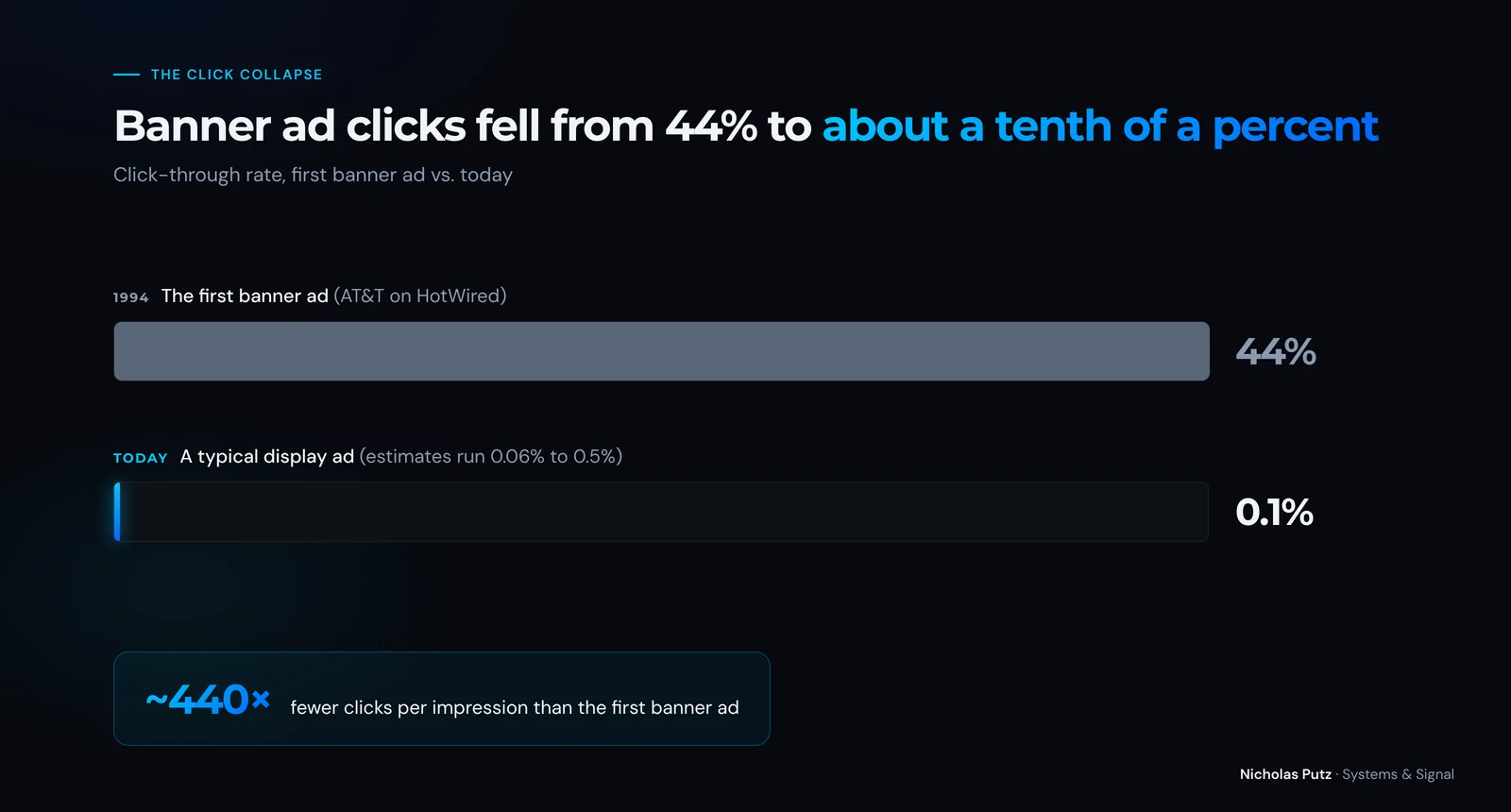
In October 1994, AT&T ran the first banner ad on HotWired. 44% of the people who saw it clicked. Today a typical display ad gets a fraction of one percent.
But here’s the twist most people miss. Nielsen found trust in online banner ads actually rose about 27% between 2007 and 2015. People didn’t hate ads more. They got used to them. They put up with them.
They just stopped doing anything about them.
Tolerance isn’t attention. That’s the numbness I’m talking about. Your ads aren’t being ignored. They’re being tolerated, which is worse, because it feels like they’re working when you’re spending more money than you should be.
The one thing that never stopped working
While every paid format rummaged for click crumbs, one signal kept climbing.
In Nielsen’s 2015 study, 83% of people trusted recommendations from people they know. By the 2021 study — 40,000 people across 56 countries — that number hit 88%. The most trusted channel on the planet. Ahead of every ad format you can buy.
People trust people. They always have. The tools change every five years. The trust requirement never does.
From “we” to “me”
Edelman’s 2025 brand trust report has a title that says it all: From We to Me. Trust has moved away from big, hollow, chest-thumping purpose statements toward something much more personal. Does this brand fit me? My values? My life?
Their 2026 report goes further: Brand Growth in an Insular World. People are pulling inward. Trusting their closest circles. Tuning out institutions. Business is still the most trusted institution, at around 62%, but Edelman’s own read is that it’s conditional and easily lost.
Now, the lazy, check-the-box takeaway is “just get your employees posting.” Don’t do that.
In 2021, Edelman found the credibility of regular employees dropped 14 points to 40%. Even “a person like yourself” fell to 53%. People can smell a canned, cringe-worthy employee advocacy program from a mile away. Your people aren’t a free pass. Real is. Forced isn’t.
Every format gets industrialized
Look at how content evolved and you’ll see the same predictable Hallmark movie on repeat.
Early 2000s: blogs and forums. A human voice, a comment section, a name you knew.
2010 to 2015: content marketing went absolutely, annoyingly nuclear. Blogs got hijacked by SEO factories pumping out endless, soulless, mind-numbing keyword soup written for Google, not people. The human voice got strangled out of brand content.
Late 2010s: video took over, and then TikTok absolutely dominated and made vertical short-form the default. And something weird happened. The shaky, unpolished phone video started destroying the slick, overproduced, five-figure shoot featuring craft services.
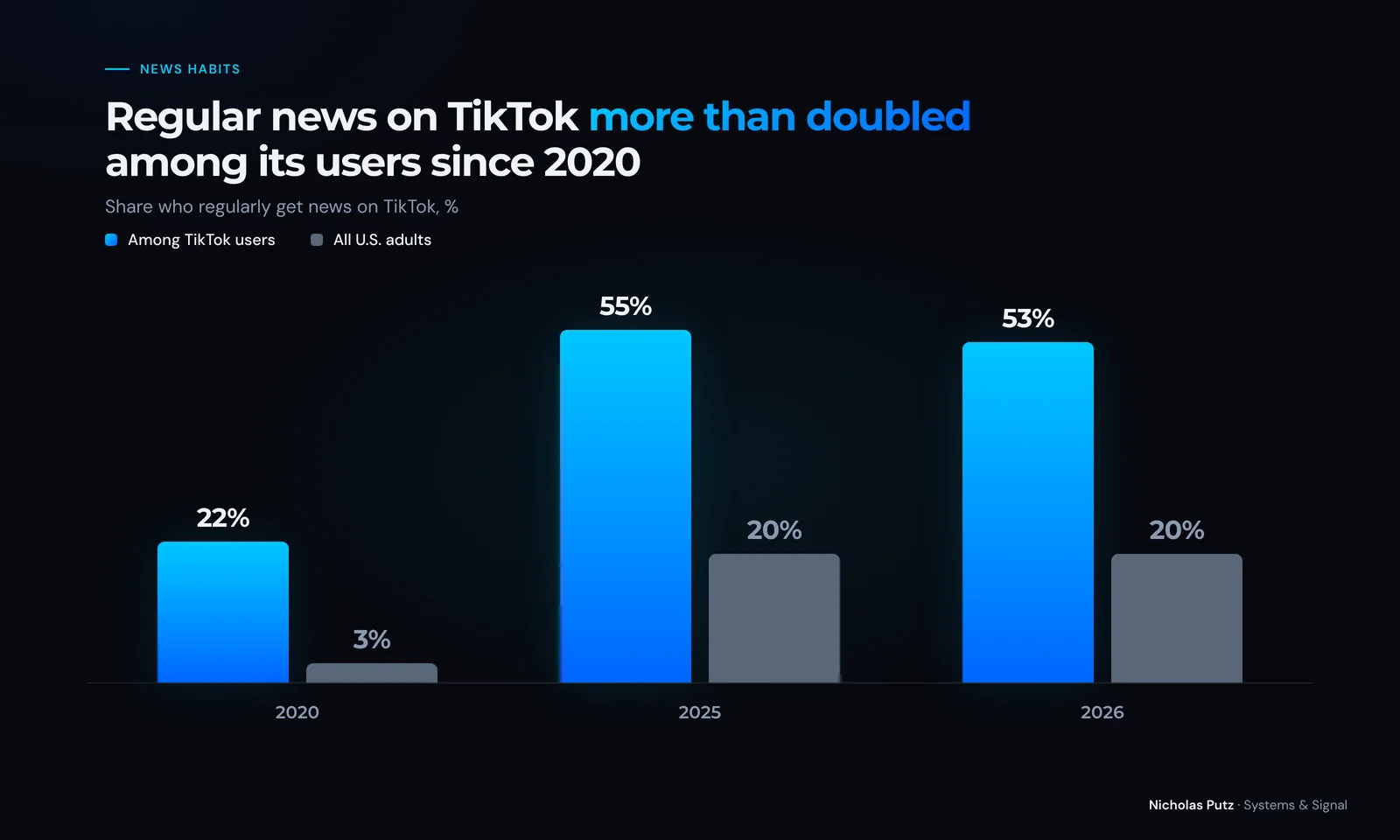
Pew’s numbers show how far it’s gone. 84% of U.S. adults use YouTube. One in five Americans now regularly get news on TikTok, up from 3% in 2020. Among TikTok users, it’s 53%.
Wyzowl — and full disclosure, they’re a video production company, so weigh it accordingly — found 63% of people would rather learn about a product from a short video, versus 12% who’d pick an article. Pew’s independent data points the same way.
The pattern here is that every format and platform gets industrialized until the humanity is turbo-sucked out of it. Then people go hunting for the next thing that still feels real and makes them feel connected.
AI just put that cycle on 10x.
From numb to sus
Here’s where things get interesting and downright unsettling if you’re a marketer.
AI is replacing the search hunt. People don’t dig through ten blue links and your “we’re the best” ad copy anymore. An AI reads you, summarizes you, and decides if you’re worth mentioning before a human ever lands on your site.
People are catching on to the slop. The endless, soulless void of copy-paste slop.
The Harris Poll, at Cannes Lions this year: 78% of consumers say AI makes ads feel less authentic. 73% would trust an ad less if they suspected AI made it. 63% are less likely to buy from brands they associate with AI-generated creative.
Fractl’s 2026 study — another vendor — found the share of people who’d trust a favorite brand less for heavy AI use doubled in a single year, from 20% to 40%.
We went from numb to actively suspicious (sus, as my kids tell me). That’s a different problem, and it needs a different playbook.
Nobody actually cares what you do
Harsh? Eh. True? Absolutely. Deal with it.
I’m going to sound negative here, but open almost any company’s website and you’ll find the same tired, interchangeable garbage. “We’re a leading provider of innovative solutions.” “We do this. We do that. We’re better than everyone.” We, we, we. We’re over it!
For years Google conditioned businesses and their SEO consultants and agencies to literally build the same products, the same way, to adapt to their algorithms.
Little boxes on the hillside,
— Malvina Reynolds, “Little Boxes” (1962)
Little boxes made of ticky tacky,
Little boxes on the hillside,
Little boxes all the same.
There’s a green one and a pink one
And a blue one and a yellow one,
And they’re all made out of ticky tacky
And they all look just the same.
Try this. Pull up your homepage. Cover your logo. Read it again.
Could it belong to any of your competitors?
If the answer is yes (and it likely is), you have a problem. Because if a human can’t tell you apart, neither can the chatbot your buyer just asked for a recommendation.
Put your ego aside. Your customer doesn’t wake up thinking about you. Not for one second. They wake up thinking about their problem. Their deadline. Their boss. Their career. Every sentence you spend talking about yourself is a sentence you didn’t spend talking about them.
There’s an old Steve Jobs principle I’ve worked by my whole career: “don’t talk about the product.” Talk about what it does for people. The product is the “what.” The value is the “why should I care.” Marketing is about values!
And here’s where it connects. In a world where AI can write “we’re the best” a million times a second, your claims are honestly flat-out worthless. Anyone can claim anything. What can’t be faked is the value a real customer got and the real people who delivered it.
So the shift isn’t just “show your people.” It’s this:
- From what you do → to what it means for the customer.
- From what you claim → to what someone else can verify.
- From a logo → to the humans who actually show up.
The value is your message. Your people are the proof that it’s true.
AI made endless claims free. When claims are free, and everyone is claiming the same thing, proof is all that’s left.
The dual web
Here’s the part most marketers are missing. You’re now marketing to two distinct audiences at once, and you need to realize this. This is the part they don’t teach you in school, so listen up.
The first is the one you know: people. They scroll, they watch, they feel your culture, and they decide if you’re real.
The second one never scrolls. It’s the machine. When a buyer asks a chatbot who’s best at what you do, an AI answers before anyone visits your site. And it can only recommend what it has learned about you.
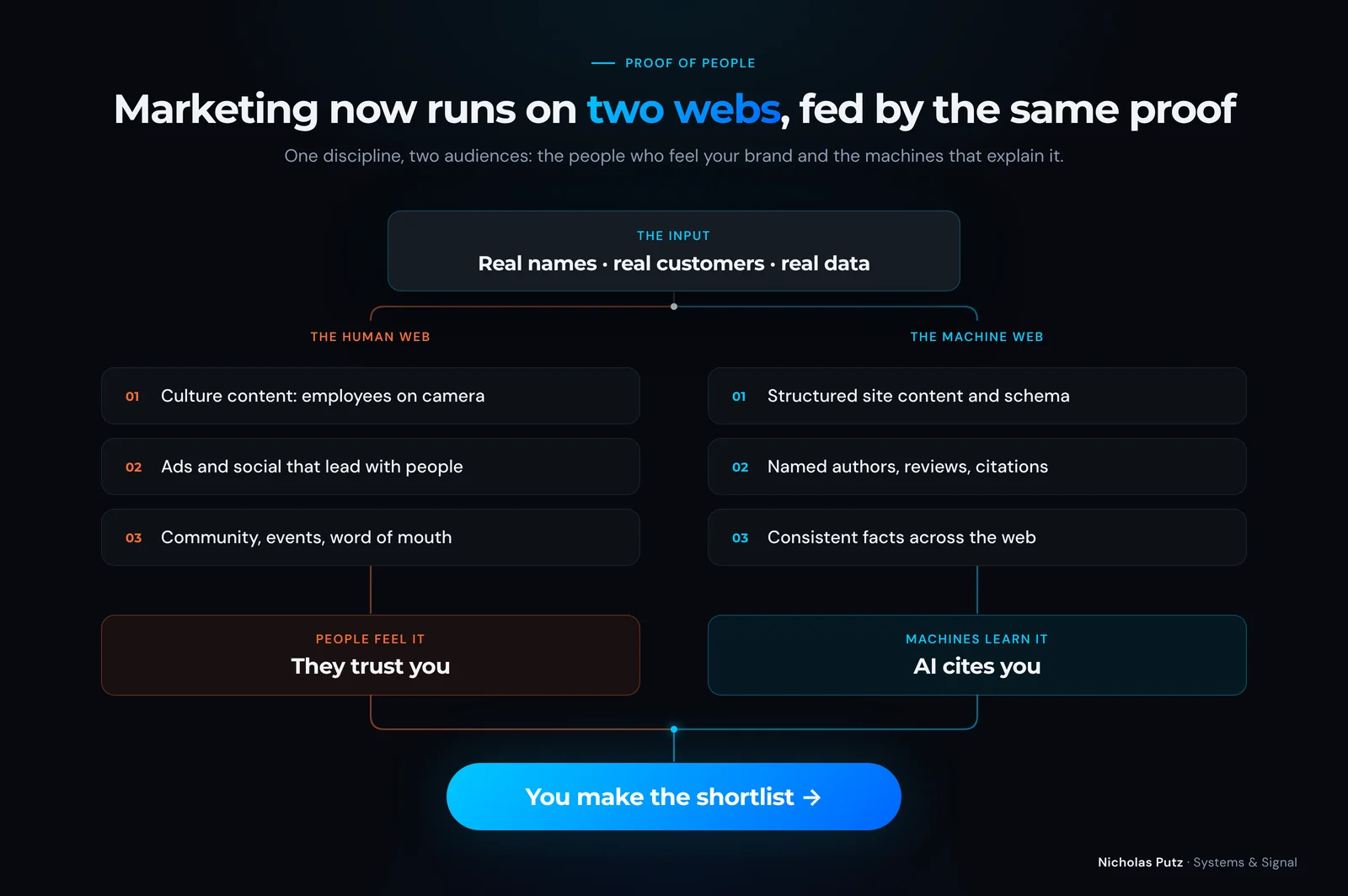
This isn’t two strategies. It’s one discipline that got bigger. The same real names, real customers and real data that win over a person are what teach a machine you exist and can be trusted. Hide your people and your values and you lose both webs at once.
What the machines are actually looking for
Forget the hacks. An AI doesn’t care how clever your tagline is. It’s trying to answer one question: can I say this about you with confidence? Here’s what earns that confidence.
- A clear story about who you are. What you do, who you do it for, where you do it. Said simply, said the same way everywhere. If your website, LinkedIn and directory listings all describe you differently, the machine shrugs and moves on.
- Other people talking about you. Reviews, press (earned media), partner pages, forum threads, podcast mentions, dare I say Reddit. A machine trusts what others say about you more than what you say about yourself. Sound familiar? It’s the same rule humans have always used.
- Real names attached to authentic expertise. Authors on your content, connected to verified sources. Bios with credentials. Leaders who show up and say something specific. Faceless, anonymous “the team” content is easy to ignore and easy to fake, and nobody actually cares.
- Straight answers to real questions. The questions your customers ask your sales team should be answered on your site, in plain language. If a buyer would ask it, a chatbot will be asked it.
- Content the machine can actually read. Your best stuff locked in a PDF, buried in a slider or hidden behind a form might as well not exist. Structure it. Mark it up. Let it be found. Stop gatekeeping. Yes, I know you want that lead information in exchange for your boring PDF, but I’m just going to put in a fake name and email to get it anyway.
- Proof that you’re alive. Fresh content, recent reviews, current team pages. A dusty, abandoned site that hasn’t changed since 2021 tells humans and machines the same thing: nobody’s home, don’t bother with this.
Notice something? Every item on that list is a version of the same thing: real people, saying real things, in places that can be verified. The machine web isn’t some alien system. It’s a very fast, very skeptical reader looking for proof of people.
SEO didn’t die. It grew up. Brand didn’t die either. It just got audited by a machine.
“But Nick...”
I can hear the pushback already. Good. Let’s talk about it!
“Performance ads still drive revenue.” They certainly do! I’m not telling you to shut off paid. I’m telling you paid is renting attention, and the rent is too damn high, costs continue to rise while the clicks keep cratering. Ads capture demand. People create it. The brands with real humans behind them get cheaper clicks because the market already believes them before the ad shows up.
“AI personalization will make brands feel more human.” Personalized isn’t personal. A machine using my first name and my browsing history isn’t a relationship. It’s a better-targeted sales pitch wearing a name tag. People can tell the difference, and the Harris numbers say they’re getting better at it every month.
“My buyers don’t even see my content. They research in private and ask AI.” Exactly. That’s the dual web. The Zero-Click. The private group chat runs on word of mouth, and word of mouth runs on real people. The AI answer runs on what the machine has learned about you. Either way, the proof has to exist somewhere it can be found.
“My team won’t get on camera.” Some won’t. Don’t force it. Forced is worse than nothing at all. It’s cringe to watch. Start with the two or three people who light up when they talk about their work. Culture is contagious when it’s authentic.
“This doesn’t scale.” That’s the point. Anything that scales infinitely, AI can now fake infinitely. The stuff that doesn’t scale is exactly what’s becoming scarce, and scarce is gold.
“My boss won’t buy into this.” Stop pitching it as a culture project. Your CEO doesn’t buy “authenticity.” Your CFO definitely doesn’t.
Then you pitch it as a risk problem: buyers and AI are filtering out generic brands, and if an AI chatbot can’t tell us apart from a competitor, we don’t make the shortlist. Tell them it’s an efficiency play: AI is already cutting production time, so this costs hours you’ve freed up, not new budget. Tell them it’s a two-for-one: the same content that builds buyer trust also recruits talent.
Then ask for a small test, not a big program. One quarter. One people series. A handful of real customer stories. Measure branded search, inbound mentions, engagement quality and whether sales hears it in conversations. Bring back results, not philosophy.
Leaders don’t fund ideas. They fund evidence. Which, if you’ve been paying attention, is the whole point of this piece.
Your people called. They want their brand back.
If you feel lost right now, you’re not behind. You’re normal. Every week there’s a new model, a new tool, a new self-proclaimed guru screaming that everything changed overnight. Most marketers I talk to aren’t short on information. They’re short on capable and informed direction.
So here’s your roadmap — the tools are the variable, trust is the constant. Ignore the noise and point everything at that. Here’s the order I’d go in.
Let AI do the grunt work. Research, drafts, data, ops. Then take every hour it buys back and spend it putting real humans in front of the market. Efficiency isn’t the strategy. It funds the strategy.
- Audit your feed. Count the posts with a real employee or customer in them vs. logos, stock photos and AI graphics. If the humans lose, flip it.
- Start a low-stakes people series. One question. One employee. One phone. Under 60 seconds. Favorite team (Go Brewers!). Favorite food. What they actually do all day. It sounds small. It’s not.
- Kill the “we.” Rewrite one ad without the word. Lead with the customer’s problem or a real customer’s words.
- Write an AI rule for your team. AI handles the grunt work. Humans own the face, the voice and the final call.
- Put real names everywhere. Team pages. Bylines. Sales reps with faces. Give buyers — and the AI reading your site — something verifiable.
- Get proof on the record. Named testimonials. Reviews. Customers on camera.
- Recruit with the same content. Job seekers and buyers are reading the exact same signals about how you run your business.
- Measure trust, not just reach. Saves, comments, DMs, inbound mentions and branded search, right next to impressions.
And if you’re a small or mid-size company, listen up: this is your advantage. The giants that are too big to fail can coast on scale. You actually know your people. Show them.
Where this goes from here
Listen, it gets worse before it gets better. More bullsh*t slop. More suspicion. More deafening noise.
Then comes the massive premium on proof. Real employees. Real customers. Real faces. Anything a buyer can verify becomes the scarce stuff.
The format matters less than ever. Blog, video, podcast, whatever. Stop telling people what you do. Show them what it means for them, and who’s behind it. The only question people are asking is: is this real?
Claims are free now. Proof is all that’s left.
AI can generate anything.
It can’t generate the trust your people or your values deserve to earn.
Stop hiding them.
A note on sources: I deliberately sought out independent data — Nielsen, Edelman, Pew, The Harris Poll — because vendor blogs are historically biased toward whatever the vendor sells. Where I used vendor data (Wyzowl, Fractl), I told you. :)
Sources
- Nielsen, Global Trust in Advertising (2015)
- Nielsen, Beyond Martech: Building Trust with Consumers (2021)
- Edelman, 2025 Special Report: Brand Trust, From We to Me
- Edelman, 2026 Special Report: Brand Growth in an Insular World
- Edelman, 2021 Trust Barometer press release
- Edelman, 2015 Trust Barometer global results (PDF)
- Pew Research Center, 8 Facts About Americans and TikTok (March 2026)
- Pew Research Center, Social Media and News Fact Sheet
- The Harris Poll, What We Learned at Cannes Lions 2026
- Marketing Brew, coverage of the Harris Poll Cannes Lions findings
- Wyzowl, State of Video Marketing 2026 (vendor)
- Fractl, 2026 AI Search Consumer Trust Study (vendor)
- Search Engine Land, coverage of the Fractl study
- Digiday, How the Banner Ad Was Born
FAQ
What is “proof of people” in marketing?
Proof of people is the idea that in the AI era, a brand’s claims are worthless because AI can generate them infinitely — what can’t be faked is the value real customers received and the real people who delivered it. Value is the message; people are the proof. Named employees, named customers, reviews, and verifiable expertise become the scarce signals that build trust with buyers and AI systems alike.
What is the dual web?
The dual web is the idea that marketers now serve two audiences at once: people, who scroll, watch, and decide whether a brand feels real; and machines, the AI systems that answer a buyer’s question before anyone visits a website. The same inputs — real names, real customers, and real data — win both. Hide your people and you lose both webs at once.
What do AI systems look for before recommending a brand?
AI systems look for confidence: a clear, consistent story about who you are across your website, LinkedIn, and directories; other people talking about you in reviews, press, forums, and podcasts; real named authors with credentials; straight answers to real customer questions; content that is readable rather than locked in PDFs or behind forms; and fresh signs the business is active.
How do you pitch a people-first brand strategy to leadership?
Don’t pitch it as a culture project. Frame it as a risk problem (if AI can’t tell you apart from competitors, you don’t make the shortlist), an efficiency play (AI-freed hours fund it, not new budget), and a two-for-one (the same content builds buyer trust and recruits talent). Ask for a one-quarter test and measure branded search, inbound mentions, engagement quality, and sales conversations.