Intelligence Dashboards
Live data pulled from your platforms, interpreted by AI into briefs your team can act on. What changed, why it changed, what to do next — instead of another login full of charts.
I build custom AI-powered intelligence applications for marketers — productivity tools shaped to how you actually work, not how a SaaS roadmap decided you should. Built on the same APIs powering frontier AI. Delivered as working software, not a deck.
Every build starts with a strategy conversation — not a signup.
The Tooling Gap
Marketing teams don't have a software problem. They have a fit problem. Every tool in your stack was built for a median customer who doesn't exist — so you bend your workflow around the product instead of the product around your workflow.
You're paying for breadth you don't use and missing the one feature you actually need. The gap between "almost right" and "exactly right" is where hours disappear.
Generic SaaS optimizes for the largest addressable market. Your edge is in what's specific to your function — and that's exactly what off-the-shelf can't touch.
Bespoke tooling meant a dev team, a long timeline, and a budget only enterprise could clear. That math is why you settled for software that almost fits. The math just changed.
The Practice
I design and ship web-based intelligence applications powered by AI APIs (Anthropic Claude, OpenAI). Not templates. Not no-code that breaks at scale. Real applications, scoped to a specific job your team does over and over — automated, interpreted, and delivered in plain language.
Live data pulled from your platforms, interpreted by AI into briefs your team can act on. What changed, why it changed, what to do next — instead of another login full of charts.
Tools that score, rank, and diagnose at scale: content audits, competitive teardowns, SEO/GEO scoring, review analysis. The work that takes an analyst a day, returned in seconds.
Internal apps that automate the repetitive judgment work — drafting, classifying, summarizing, routing — calibrated to your voice and your standards, not a generic model's defaults.
Client-facing or internal apps that turn your proprietary data or methodology into a productized, reusable asset. Build it once, deploy it across every account.
Built & Shipped
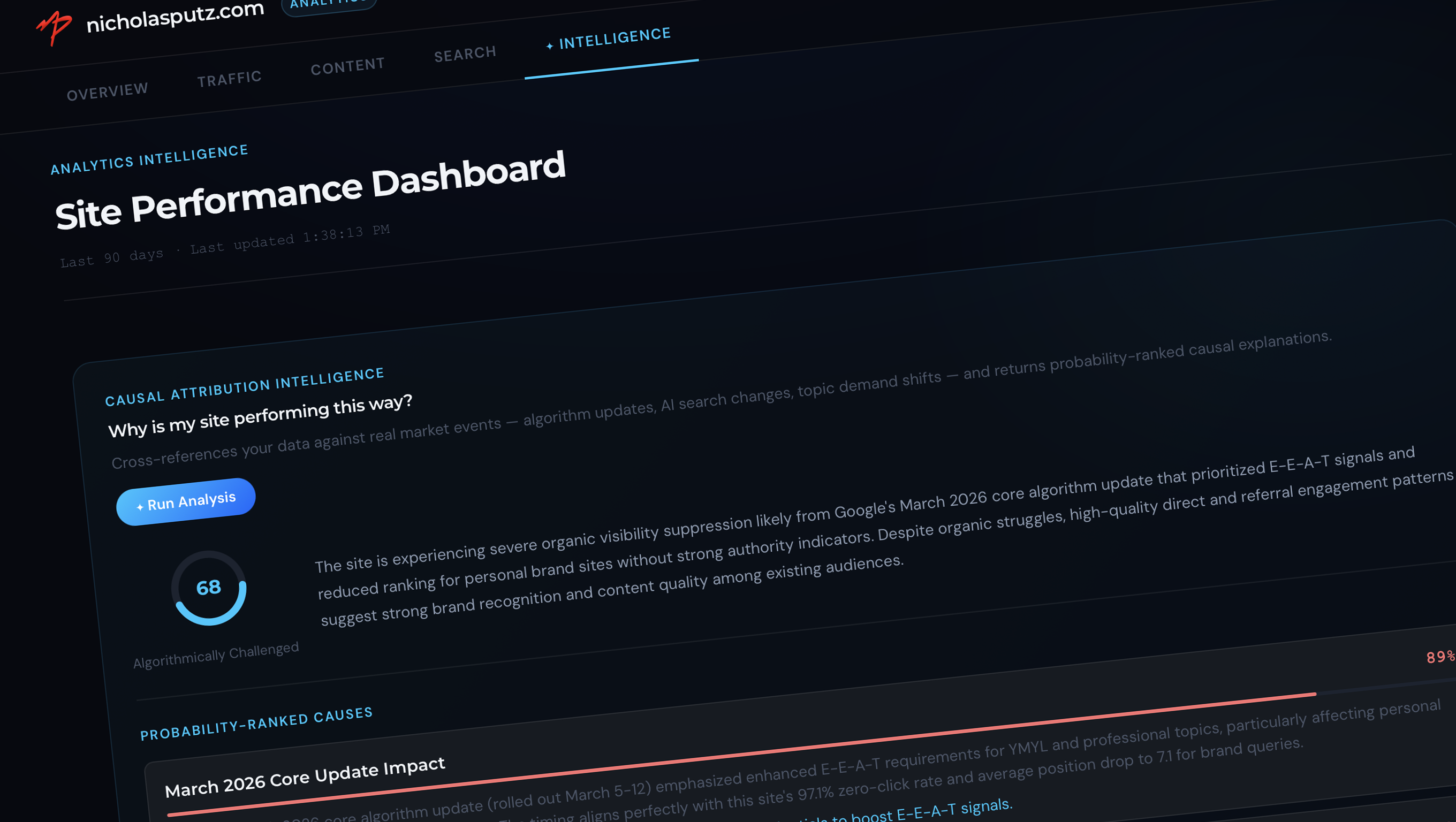
The clearest example of what this practice produces: a live, AI-powered marketing intelligence dashboard with four systems running on real client data — Executive Brief, Search Visibility Advisor, Causal Attribution Intelligence, and Channel Quality signal. It interprets GA4 and Search Console the way a dedicated analyst would. It's not a concept. It's deployed, validated against messy production data, and serving marketing directors today.
Explore Analytics Intelligence →This is one build. Yours starts with the problem only your team has.
The Engagement
We start with a conversation, not a quote. What's the repetitive, high-friction job? Where does interpretation break down? What would the right tool actually do? Scope and fit get defined here.
I design and develop the application — architecture, AI integration, interface. You see working software in stages, not a six-month black box. Practitioner judgment is baked into the logic, not bolted on after.
The app goes live in your environment. We calibrate against real usage, tighten the outputs, and extend as your needs evolve. You own a tool that fits — and keeps fitting.
Why This Works
Most "custom tool" pitches route through a developer who's never run a marketing function and a strategist who can't build. I'm both. Sixteen years running marketing — and a portfolio of AI applications built and deployed in production, not slideware. That means the tool gets scoped by someone who understands the actual job, and built by the same person. No translation layer. No requirements lost in handoff.
Common Questions
Custom, web-based intelligence applications for marketers, powered by AI APIs like Anthropic Claude and OpenAI. That spans interpretation dashboards, analysis and audit engines, workflow copilots, and productized data tools — each scoped to a specific recurring job your team does. It's working software built for your workflow, not templates or no-code that breaks at scale.
A typical agency routes your idea through a strategist who can't build and a developer who has never run a marketing function. I'm both — sixteen years running marketing plus a portfolio of AI applications shipped in production. The person who scopes the tool is the same person who builds it, so nothing gets lost in translation or watered down in a handoff.
Pricing follows scope, not a fixed menu. Because every build solves a different problem, I price after a short strategy conversation where we define the job and the smallest version that delivers real value. Reach out with your problem and you'll get a straight read on feasibility, approach, and investment — no obligation.
Most focused tools ship in weeks, not months. The AI layer now replaces what used to require large custom codebases, which collapses the timeline. You see working software in stages rather than waiting months for a single reveal.
No. Everything is delivered as a working web application with the technical complexity handled underneath. The interface and outputs are plain-language and built for marketers — not engineers.
Builds use leading AI APIs such as Anthropic Claude and OpenAI, with read-only, scoped data access and no storage beyond what the tool needs to function. Your data powers your tool — it is never shared or repurposed.
No — it's the flagship example of the practice, not the whole menu. The same approach builds whatever recurring, high-friction job your team faces. The Analytics Intelligence dashboard simply shows what "shipped, validated, and serving clients" looks like in production.
Pricing & Strategy
Every build is scoped to the work, so pricing follows strategy — not the other way around. Reach out with the problem you're trying to solve and I'll respond personally with a read on feasibility, approach, and investment. No automated sequences. No commitment to start the conversation.
That's not a problem. That's the conversation we start with.
Start With Strategy →Every build starts with a strategy conversation — not a signup.